
This bloog is my personal property, where I express my admire, feelings, comments, suggestions and objections about any thing. Hope you will give me your support to make it better. ለኢትዮጵያ !!
Sunday, November 25, 2012

Stop sending Ethiopian asylum seeking journalists to Kality: Johan Persson
Reporter Martin Schibbye and photographer Johan
Persson became world famous in 2011 when they were arrested, threatened with
death, arrested and sentenced to eleven years in prison accused of terrorism by
Ethiopian authorities.
Everything on the basis that the two Swedish
journalists on a reporting in Ethiopia had interviewed one of the parties in
contentious cases of recovery and autonomy
After 14 months and persistently Swedish diplomacy,
the two were freed and could return home to Sweden 14 September 2012. In
October, they finally receive Publicistklubbens price in Anna Politkovskaya
memory they were assigned while still imprisoned, and the same month came the
announcement that they get Ludvig Nordström Award 2013.
·
December is the stage in Dokkhuset. Their
history, their fellow prisoner’s stories and a nation's abuse of free speech to
spread.
As Martin
Schibbye said:
"Ethiopia managed to captivate us two
journalists. But they never succeeded in silencing journalism.
Saturday, November 24, 2012
Wednesday, November 21, 2012
Ethiopia Unqualified for Human Rights Council Seat

Meles
Zenawi, Ethiopia’s taciturn, ironfisted ruler, passed away after 21 years of
increasingly autocratic rule, leaving the country and its global allies at an
interesting and rare crossroads: Will the country continue along its current
path of political authoritarianism and its extensive machinery of suppression,
or will we see the rights of Ethiopian people restored in an more transparent,
accountable politicalsystem? Amnesty International
The United States is competing with four Western
countries for three seats on the Human Rights Council in the only contested
election at the U.N.’s top human rights body.
The 193-member General Assembly is scheduled to vote
Monday for 18 members of the 47-member council.
African, Asian, Eastern European and Latin American countries have put forward uncontested slates whose
candidates are virtually certain of victory.
Several human rights groups have criticized a number
of these candidates as unqualified including Ivory Coast, Ethiopia, Gabon,
Kazakhstan, Pakistan and Venezuela.
The five Western nations competing for seats — the
U.S., Germany, Greece, Ireland and Sweden — were all deemed qualified by the
rights groups.
Hillel Neuer, executive director of the Geneva-based
advocacy group UN Watch, called the absence of competition in four out of the
five regional slates “scandalous.”
He said at the group’s annual luncheon at U.N.
headquarters ahead of the vote, on Friday, that the United States was the last
of the five candidates to enter the race and found that many countries had already
made commitments to the other candidates.
“Most people that I’ve spoken to say America is
polling somewhere either fourth or fifth,” he said. “If they do lose … we think
it will be a setback for the council. We don’t agree with everything America
has done but UN Watch thinks America has been a leader of the few good things
that have occurred.”
Philippe Bolopion, United Nations director for Human
Rights Watch, said that to its credit, the Western group is the only regional
group allowing true competition in Monday’s election.
“As a result, and despite its highly effective
engagement in the Human Rights Council, the U.S. faces a tough yet healthy
competition,” he said.
Bolopion said it was sad that the Africa, Asian,
Eastern European and Latin American groups at the U.N. “have pre-cooked this
election by offering as many candidates as they have been allotted seats.” He
said this is “making a mockery” of the standard set by the General Assembly that all candidates for
the council “uphold the highest standards” of human rights.
The Human Rights Council was created in March 2006 to
replace the U.N.’s widely discredited and highly politicized Human Rights
Commission. But the council has also been widely criticized for failing to
change many of the commission’s practices, including putting much more emphasis
on Israel than on any other country and electing candidates accused of serious
human rights violations.
Former President George W. Bush’s administration
boycotted the council when it was established over its repeated criticism of
Israel and its refusal to cite flagrant rights abuses in Sudan and elsewhere.
But in 2009, then newly elected President Barack Obama sought to join the
council saying the U.S. wanted to help make it more effective.
In that contest, the U.S. was elected on an
uncontested slate winning 167 votes, far more than the 97 vote majority needed.
Amnesty International’s U.N. representative, Jose Luis
Dias, said member states “should return a blank ballot if they feel a candidate
does not meet the high human rights standards expected of council
members.”
Amnesty has written letters to all candidates urging them
to demonstrate their commitment to human rights, he said.
For example, Dias said, the organization has called on
Ethiopia to instruct the security services to remove barriers to the work of
human rights defenders and journalists and has highlighted Ivory Coast’s 2010
Supreme Court ruling upholding a husband’s right to “discipline his wife and
children, provided that this left no visible marks.”
Tuesday, November 20, 2012
Journalism is not Terrorism: EFF
Electronic Freedom Foundation Calling on
Ethiopia to Free Eskinder Nega
By Rainey Reitman | Electronic Freedom Foundation

Eskinder
Nega, an award-winning journalist who has been imprisoned for over a year,
appeared briefly in court to appeal the terrorism charges levied against him.
Eskinder has unwaveringly denied the charges, maintaining that blogging about
human rights abuses and democracy is not a form of terrorism. In July, Eskinder
was sentenced to 18 years in prison for his reporting. In court this week, his
appeal was cut short: according to one report EFF received from partners
working on his case, Eskinder was not allowed to read his defense statement and
the appeal was rescheduled to November 22. We are continuing to seek
confirmation about the status of the trial. For now, we’re asking concerned
individuals to join us in calling on the Ethiopian government to live up
to the promises in their own Constitution and free Eskinder Nega.
While many journalists have either fled Ethiopia or
been silenced by repressive policies, Eskinder Nega has become a national
symbol for press freedom. Educated in the United States in the 1980s, Nega
studied political science and economics at American University.
He subsequently returned to Ethiopia where he has worked as a journalist for
over twenty years. Nega founded 4 newspapers –all of which were shut down by
the Ethiopian government –and has been jailed 9 times in the last two decades
for his outspoken articles.
Upon his release from prison in 2007, Nega’s
journalism license was revoked and he was banned from working on newspapers. He
immediately turned to the Internet and began using blogs to speak out. Some of
his work has been published on Ethiomedia, a blog that is inaccessible from inside Ethiopia.
Four years later in 2011, Nega was the recipient of
the PEN/Barbara Goldsmith Freedom to Write Award. Peter Godwin, President on
the PEN American Center, noted that Eskinder understood the risks of
continuing to speak out publicly:
He
went back into the breach knowing full well what the risks were for doing so.
He had a number of other options. He grew up in the DC area. He could have left
the country, but he chose to stay. He’d been arrested 6 or 7 times before, he’s
had newspapers closed down. He’s really been hounded by the Ethiopian regime.
Birtukan Midekssa, a former federal judge and
opposition leader in Ethiopia, says Nega has been unwavering even in the face
of death threats from the police. Midekssa said: “At some point, they told him
that, you know, they are tired of arresting him. And they said, this time
around, we are not going to arrest you, we are going to kill you. Better stop
it. But he can’t, you know. He can’t stop. That’s him.”
Already targeted by police, Eskinder Nega drew even
more ire from the Ethiopian government when he continued to blog about the Arab
Spring uprisings. Through articles like As Egypt and Yemen
protest, wither Ethiopia’s opposition? and Egypt’s and
General Tsadkan’s lesson to Ethiopian Generals, Nega discussed the implications of the pro-democracy movements in
North Africa and the Middle East on Ethiopia. Nega was picked up by the police
in February 2011. According to a harrowing account Nega wrote afterwards, he was interrogated
at length about his journalism, and the police threatened to seek retribution
against him if protests broke out in Ethiopia.
Where are all the Newspapers? The Plight of
Independent Press and Ethiopia’s Internet Access
To understand the risk –and importance—of Nega’s work,
one must first understand the status of independent media in Ethiopia. TheEthiopian
Constitution promises to uphold freedom of expression,
stating: “Everyone has the right to freedom of expression without any
interference. This right shall include freedom to seek, receive and impart
information and ideas of all kinds, regardless of frontiers, either orally, in
writing or in print, in the form of art, or through any media of his choice.”
But Ethiopia has a dark history of shutting down newspapers and imprisoning
journalists.
Immediately prior to the 1990s, there was no
independent media to speak of in Ethiopia as the country struggled under a
Communist regime and devastating famines. The early 1990s saw major political
change in the country. Communism was ousted, a bicameral legislature and
judicial system were created, and a new Constitution was written and enacted.
Meles Zenawi, who would prove himself deeply aligned with U.S. interests,
governed—initially as President, then as Prime Minister. While in some way
Zenawi helped Ethiopia to recover after many difficult years of conflict and
depravation, his government was marked by an intractable disrespect for human
rights and press freedom.
In 1992, Ethiopia issued a Press Proclamation that, in
addition to other restrictions on free expression, gave the government the
ability to shut down publications that printed “false” information. Ethiopia
became one of the leading countries in imprisoning journalists during the
1990s, trailing only Cuba and China.
In the lead up to the 2005 election, there was a brief
period of improved journalistic freedom in Ethiopia. However, the aftermath of
the controversial election brought a severe crack down on independent media.
Even as clashes between government troops and protesters left dozens of civilians
dead, law enforcement began a witch-hunt for journalists. Dozens of journalists
were arrested and charged with serious crimes such as treason and even
genocide. Some of these journalists faced decades in prison or even the death
sentence.
Along
with issuing its “wanted lists,” the government raided newsrooms, blocked
newspapers from publishing, and expelled two foreign reporters, including a
long-serving Associated Press correspondent. About a dozen exiled Ethiopian
journalists were charged in absentia with treason. The U.S. government-funded
Voice of America and Germany’s Deutsche Welle, which broadcast radio programs
into Ethiopia in local languages, were targeted by smear campaigns in state
media, endangering their local correspondents…Eight newspapers were shut as a
result of criminal indictments and the jailing of their top journalists.
Many of the journalists who were not arrested fled the
country or stopped reporting. The few newspapers that survived the purge
increased their self-censorship.
Eskinder and his then-pregnant wife, Serkalem Fasil, a
newspaper publisher, were both arrested during the 2005 crackdown on dissent.
They each spent over a year in prison.
In Ethiopia today, journalism is still a dangerous
occupation. In July 2009, the Ethiopian parliament passed the Anti-Terror
Proclamation, a sweeping piece of “anti-terrorism” legislation that’s been used
to imprison journalists and political dissidents. Amnesty International
researcher Claire Beston, who was expelled from Ethiopia in August of last
year, has criticized the application of the law, noting: “Since the law has been introduced, it’s
been used more to prosecute opposition members and journalists than persons who
might be committing so-called terrorist activities.”
Eskinder Nega criticized the anti-terrorism law just
before he was arrested for violating it. In the article, Eskinder pointed to
Debebe Eshetu, a famous actor, whose imprisonment under the anti-terrorism law
Eskinder said “defies logic.”
The problems with press freedom in Ethiopia are
compounded because the majority of the population can’t get to the open
Internet, which might otherwise give them access to international news outlets.
Part of this is due to difficulties in accessing the
Internet at all. Internet penetration in Ethiopia is among the lowest in all of
sub-Saharan Africa. According to Open Net Initiative’s 2009 report, the majority of Internet access in the country occurs in Internet
café, most of which are in the capital city. These cafes provide slow and
unreliable service. As Nega noted in 2011, Internet access in Ethiopia is slow
and cumbersome to use: “It is hard to sign in and out of a simple email window.
Fast broadband Internet gave birth to the North African revolution, and now the
revolution-phobic EPRDF-led Ethiopian government [Ethiopian People's
Revolutionary Democratic Front] is struggling against fast internet access.”
But even Ethiopians who can get online often can’t
reach independent, international news. The only telecommunications service
provider for all of Ethiopia is the state-owned Ethiopian Telecommunications
Corporation (Ethio-Telecom), which heavily censors access to the open Internet. Tests conducted by the Open Net Initiative in
September 2012 showed that online political and news sites are heavily blocked
within the country.
In June, EFF reported on recent increases in the censorship and
surveillance practices in Ethiopia. Ethio-Telecom began deep packet inspection
of all Internet traffic in the country, which engineers at the Tor Project discovered when Tor stopped working there in May of
this year.
In the same month, the government of Ethiopia ratified
the newTelecom Service Infringement Law.
This law criminalizes online speech that may be construed as defamatory or
terrorist, and holds the website or account owner liable even if the speech is
posted as a comment by someone else on their website. Endalk, a prominent
Ethiopian blogger, has wondered if this law could be “the most creative way of
copying SOPA and PIPA.” The law also tries to squash competition of VOiP
services and harshly punishes citizens for using or having in their possession
any telecommunications equipment without prior permission from the government.
Through law and practice, through intimidation and
arrest, the Ethiopian government has looked to choke off free expression at
every corner. It is no wonder than Eskinder Nega is one of the few outspoken
journalists still operating inside Ethiopia.
Eskinder’s Current Conditions
While we are unable to receive direct reports from
Eskinder about his current physical conditions, our knowledge of the prison
system in Ethiopia leaves us gravely concerned.
Prison
and pretrial detention center conditions remained harsh and in some cases life
threatening. Severe overcrowding was common, especially in sleeping quarters.
The government provided approximately eight birr ($0.46) per prisoner per day
for food, water, and health care…Medical care was unreliable in federal prisons
and almost nonexistent in regional prisons. Water shortages caused unhygienic
conditions, and most prisons lacked appropriate sanitary facilities.
Wikileaks published a diplomatic cable that was called “Inside Ethiopia’s jails”
that is far more graphic than the State Department’s annual report. The cable,
based on reports from several recently released prisoners, detailed extreme
deprivation, including:
“Abuses
reported include being blindfolded and hung by the wrists for several hours,
bound by chains and beaten, held in solitary confinement for several days to
weeks or months, subjected to mental torture such as harassment and
humiliation, forced to stand for over 16 hours, and having heavy objects hung
from one’s genitalia (males).”
Even though the cables noted that much of the torture
occurred in police station detentions, the threat of torture in the Kaliti
Prison (where Eskinder is being held) is still possible. We are deeply
concerned about the physical condition of Eskinder.
Freeing Eskinder Nega (and Helping All of
Ethiopia’s Imprisoned Journalists)
Freeing Eskinder Nega will help preserve a vital voice
for independent journalism in a country that hungers for access to truthful
news coverage. It will also serve as inspiration for activists working to free
other imprisoned journalists in this country.
The Ethiopian government has released journalists in
the past—including Eskinder, several times. Earlier this year, it released and
pardoned Swedish journalists Johan Persson and Martin Schibbye after
substantial international pressure. And in August, Temesghen Desalegn, editor
of a leading independent weekly newspaper in Ethiopia, was released and cleared of the criminal charges against
him. So we know that activist efforts – including international pressure – can
be persuasive to the Ethiopian government. If nothing else, continued
international attention can help ensure Eskinder Nega’s safety as he continues
to appeal his case.
Here’s how you can get involved:
• Sign PEN American Center’s petition, which automatically an email to Prime Minister Meles Zenawi and Minister of Justice Berhanu Hailu.
• Send appeals by mail to Ethiopian officials and their local Ethiopian Embassy or Consulate.
• Tell your friends on Facebook and Twitter. Suggested Tweet:
Journalism is not terrorism. Join @PenAmerican and @EFF in fighting to #FreeEskinder Nega. http://www.pen.org/page.php/prmID/2226
• Sign PEN American Center’s petition, which automatically an email to Prime Minister Meles Zenawi and Minister of Justice Berhanu Hailu.
• Send appeals by mail to Ethiopian officials and their local Ethiopian Embassy or Consulate.
• Tell your friends on Facebook and Twitter. Suggested Tweet:
Journalism is not terrorism. Join @PenAmerican and @EFF in fighting to #FreeEskinder Nega. http://www.pen.org/page.php/prmID/2226
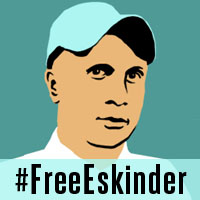
We’re also going to be changing the EFF Twitter
profile image to show a #FreeEskinder banner leading up to Eskinder’s next
appeal. We hope you’ll do the same to your own online accounts by using the
image located here.
The United States has deep ties with Ethiopia, which
is a major military alley for our country in sub-Saharan Africa. EFF is writing
an open letter to the US State Department to urge them to speak out on
Eskinder’s case to Hailemariam Desalegn, Ethiopia’s new Prime Minister. As the
Washington Post stated, Eskinder’s case is “a source of tension
and embarrassment to the Obama administration,” whose new Africa strategy makes
democracy promotion the number one priority.
We’ll be watching Eskinder’s case closely in the
coming months. Follow us on social media and sign up for our newsletter to stay
up to date on the campaign.
Follow EFF
Journalism is not terrorism. Join @PenAmerican and
@EFF in fighting to free #EskinderNega https://eff.org/r.a7qY
What is the purpose of a government?

By Magn Nyang (PhD)
The
purpose of government is to provide a system in
which individuals give portion of their freedom in order to pursue needs and
wants without the fears that are inherent in a state of anarchy.
In
an anarchic system, individuals must protect and provide completely for
themselves, and those with greater power are able to offend those with lesser
power without consequence. In a system of government, the freedom to acquire
and offend at will is subjugated to the will of the governed; and, in return,
the governed are better able to produce without fear of loss.
Therefore, at its most basic level, the purpose of government is to protect the people from threats, both within and out.
Government also ensures justice within the nation. Meaning, the law must
be fair, unbiased, and logical, provides a basic system of defense against
enemies of the state, and provides education, infrastructure, and health
facilities. The most fundamental ofhuman needs
which includes education, food, health facilities are satisfied through the
policy of governance. Government provides infrastructure so that these needs
are met.
Some naïve Ethiopians are foolishly praising the Ethiopian People’s Revolutionary Democratic Front (EPRDF) for providing education, infrastructure, and health facilities. The EPRDF is expected to provide all these services to Ethiopians. In fact, EPRDF is required to provide more services than it has provided thus far. I, personally, do not see the logic of praising a government when it is minimally doing only what it is supposed to do. Instead of congratulating a dictatorial government, we, Ethiopians, should be asking about human right issues. Where are our freedom, equality, and liberty?
In 21 years, the EPRDF not only failed to move Ethiopians toward self sufficiency, it has managed to effectively reduce Ethiopians to nothing, but recipients of foreign donations. For the past 21 years, the EPRDF did not only block us from realizing our dreams of freedom, equal rights and self-determination for all, it also subjected us to decades of subjugation and exploitation.
Over the years, I have also heard some EPRDF officials and their supporters say that “Ethiopians are not yet ripe for democracy/freedom.” They say that it will take more time to prepare them or to get them ripped.
If one accepts this assumption, democracy/freedom will never be achieved in Ethiopia; for one cannot arrive at the maturity for democracy/freedom without having already acquired it; one must be free to learn how to make use of one’s powers freely and usefully. One can achieve reason only through one’s own experiences, and one must be free to undertake them. To accept the principle that freedom is worthless for those under one’s control and that one has to sit idle to let his rulers rule forever, is an infringement on the right of God himself, who has created man to be free.
All men have rights to be free and equal, and governments are instituted among men to secure these rights. The government in Ethiopia has become illegitimate for it continues to block Ethiopians from achieving their freedom and equality. Thus, when a government becomes destructive of these ends, it is the right, it is the duty of the people to abolish it and institute new government.
Dr.
Magn Nyang can be reached at magnnyang@yahoo.com
Monday, November 19, 2012
Wednesday, November 14, 2012
OLF on Death of Zenewi

Death of Zenewi should be transmitted to the death
of TPLF
OLF Press release:
The Death of Melese Zenewi should be transmitted
into the death of TPLF rule of minority domination and exploitation in Ethiopia
The death of the tyrant who has been terrorizing the Ethiopian
people for the last 21 years is indeed good news. But we are saddened for
his natural departure without facing justice for the thousands Ethiopian who
were murdered by his orders. However, it’s incremental step for the demise of
minority hegemony in Ethiopia. But, it is not a time for jubilation at all. The
struggle for freedom and justice in Ethiopia must be intensified until the
minority hegemony in Ethiopia is replaced with true freedom, democracy and rule
of law where the Ethiopian peoples’ will choice their leaders without fear of
intimidation, arrest, torture and extra judicial killing. The struggle against
woyane dictatorial regime will continue until all Ethiopian peoples’ freely
exercise their God given rights of self determination in their affairs.
The Oromo Liberation Front (The OLF) calls
upon all Ethiopian people irrespective of regions and religions, opposition
forces, and Ethiopian defense forces to stand together in dismantling woyyanne
minority regime, and contribute for the establishment of true freedom and
democracy in Ethiopia
The OLF also calls up on International community to stand with Ethiopian peoples in their effort to establish genuine freedom, democracy, and rule of law in Ethiopian. The OLF believes standing with tyrannical minority rule for temporary benefit will have a negative consequence for long and lasting relation with Ethiopian peoples. Once again, we call upon western powers to stand with Ethiopian peoples, not with TPLF/ EPRDF/ minority rule which is on the verge to collapse.
The OLF also calls up on International community to stand with Ethiopian peoples in their effort to establish genuine freedom, democracy, and rule of law in Ethiopian. The OLF believes standing with tyrannical minority rule for temporary benefit will have a negative consequence for long and lasting relation with Ethiopian peoples. Once again, we call upon western powers to stand with Ethiopian peoples, not with TPLF/ EPRDF/ minority rule which is on the verge to collapse.
General Kamal Galchu
Chairman of the OLF
Tuesday, November 13, 2012
German NGO pulls out of Ethiopia in protest of repression
Named after the German
Nobel Prize winner for Literature, the Heinrich Böll Foundation is an NGO
promoting democracy and human rights. It is leaving Ethiopia in protest against
restrictions on its activities.
“The closure of the office in Ethiopia is a sign
of protest by the foundation against the ongoing restrictions on civil rights.

200
people were killed in Ethiopia while protesting against ballot-rigging in 2005 and freedom of speech” said a statement
released by the Heinrich Böll Foundation explaining why they had closed their
office in the Ethiopian capital Addis Ababa.
The organization’s chairwoman Barbara Unmüßig and
the country director Patrick Berg said it had become impossible for the
organization to work for democracy, gender equality and sustainable development
under existing circumstances. They were referring to the law on NGOs passed in
2009 which is known as the “Charities and Societies Proclamation” and restricts
freedom of press, expression and assembly.
The law that worsens human rights
This “NGO law” severely curtails the activities of
nongovernmental organizations and human rights groups. It is targets not just
foreign groups, but also Ethiopia’s two largest human rights organizations.
According to the rights group Amnesty
international, the Ethiopian Human Rights Council (HRCO), which has been active
since 1991, had its bank account frozen under this law. Nine of its twelve
offices have been closed and 85 percent of its staff laid off.
The women’s rights organization Ethiopian Women
Lawyers Organization (EWLA) was forced to lay off 75 percent of its staff and
assets worth $595,000 (468,000 euros) were frozen. Previously, the organization
was able to give free legal assistance to some 20,000 women, nowadays it is
barely able to function, says Amnesty international.
Germany’s Heinrich Böll Foundation, which is
affiliated to the Greens Party, had been trying for three years to get a
bilateral agreement signed with the Ethiopian government which have would
granted it more room for manoeuvre than it would have been accorded under the
NGO law. But such efforts were in vain.
Appeal at ministerial level in vain
They even tried to raise the issue with the Ethiopian government through
the offices of German Development minister Dirk Niebel while he was on a visit
to Addis Ababa, but that also yielded no results.
“We realized that we cannot pursue our mission and
we can no longer support our local partners of several years,” Patrick Berg
told DW.
Berg said “NGO law” was part of a system of
repression and symbolic of deterioration in human rights that had spread
through the country since the elections in 2005. 200 people were killed in
demonstrations against ballot-rigging in that poll.
Official Ethiopian government spokesman Bereket
Simon was quoted by German’s news agency DPA as saying the government would be
“delighted if the Heinrich Böll Foundation would continue its work in
Ethiopia.”
The departure of the Heinrich Böll Foundation
leaves the Friedrich Ebert Foundation as the only remaining German think tank
in Ethiopia.
Monday, November 12, 2012
Sunday, November 11, 2012
Subscribe to:
Comments (Atom)